


If you’ve been wondering whether blogging is still worth it now that AI can answer a question before someone ever clicks through to a website, I get why you’d ask.
Search looks different than it did even a few years ago. Google can summarize answers right at the top of the results. People are asking ChatGPT questions they once would have typed into a search bar. And approximately eleven billion AI-generated blog posts seem to appear every time you blink.
So, as a small business owner, you might reasonably be wondering:
Why would I spend my time writing blog posts now?
Here’s where things get interesting.
I actually think this shift creates an opportunity for small businesses—especially businesses built around real expertise.
Because AI hasn’t made useful information less valuable. If anything, it has given genuinely useful, specific, firsthand information more places to be discovered.
And I know that because I accidentally ran a little experiment of my own.
My tiny five-post blog taught me something about AI search
I have another website called Home of Henderson, which I started while we were building our house on the South Carolina coast.
It was mostly a place to document the process and share the kind of information I desperately wanted when I was Googling everything under the sun before we built.
And this is not some SEO powerhouse we’re talking about.
At the time I started seeing results, the site had something like five blog posts.
Five. (Truly, it might have even been FOUR at that point). It was a baby website in every conceivable way. No years of domain authority behind it. No enormous library of content. No sophisticated backlink campaign.
But I did have one thing going for me:
I had actually built the house.
I wasn’t researching what it might cost to build with Schumacher Homes and cobbling together an article from other people’s information.
I had the budget. I had lived through the decisions, the upgrades, the surprises, and all the oh, apparently THAT costs extra moments.
And I remembered exactly what I had wanted to know when I was the person searching.
So I wrote about it.
I shared real numbers and actual experience—including budget transparency around what it cost us to build.
And within weeks, Google started showing those posts in search.
Not years. Weeks.
On a site with five freaking blog posts.
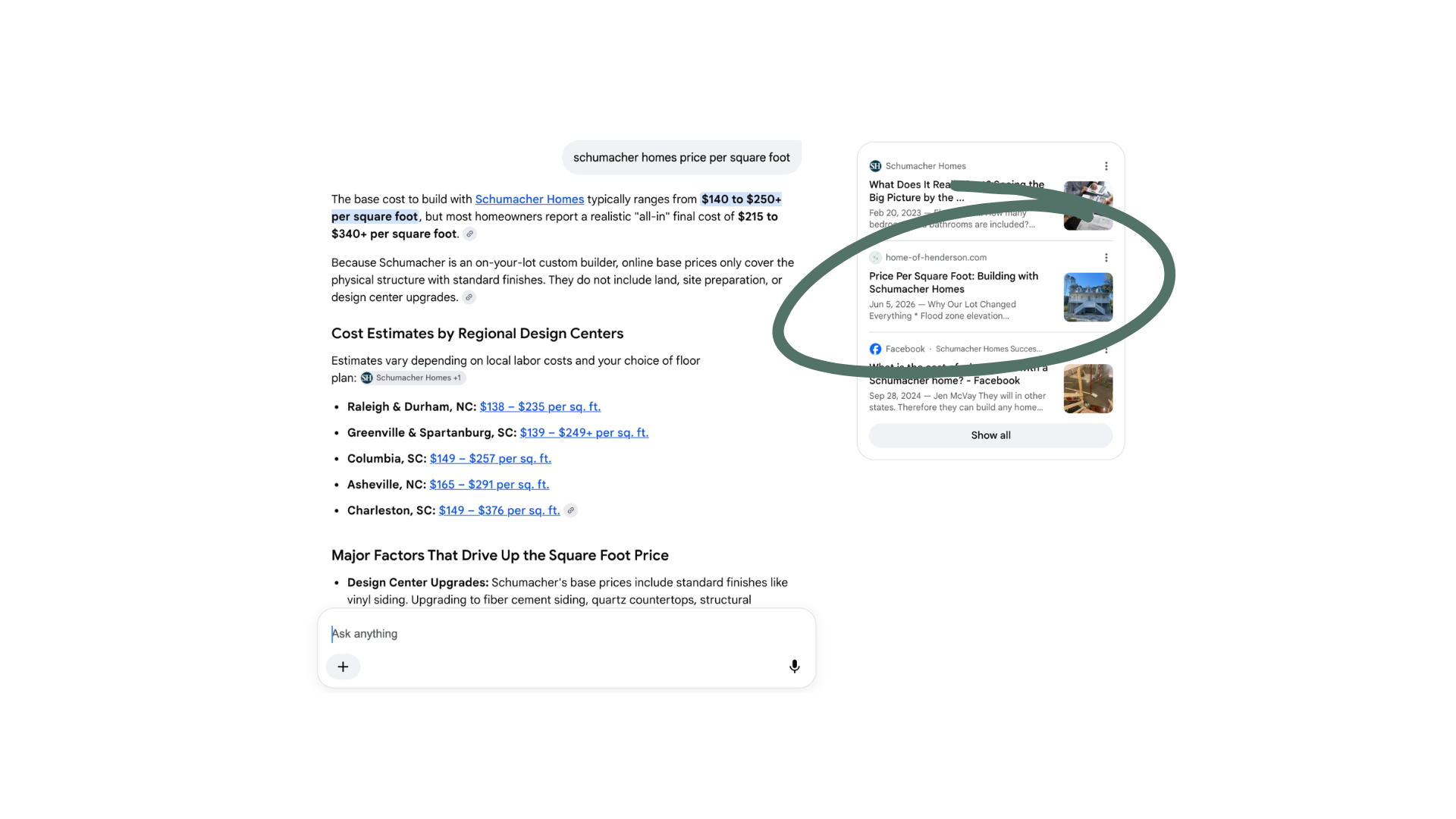
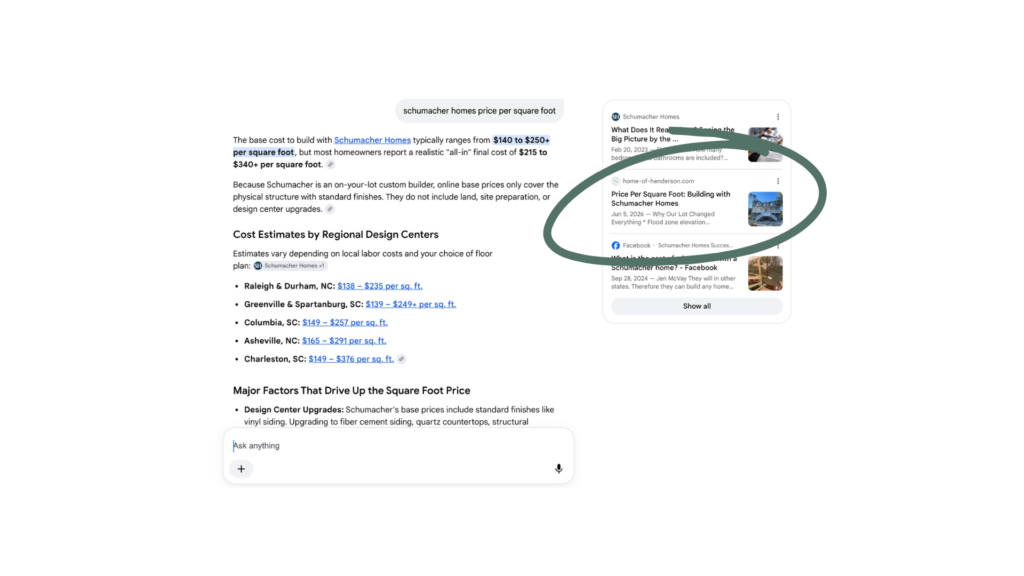
Even more interesting, my content has appeared in Google’s AI Overview for a search related to Schumacher Homes cost.
Now, I am absolutely not telling you that publishing five blog posts is a magical shortcut to Google rankings or AI citations. Search results change. AI Overviews change. Traditional SEO signals still matter.
But I am telling you that this tiny website had something useful to contribute to a very specific conversation.
I had an answer people were looking for—and I was willing to give them the useful version.
And I think that tells us something pretty important about blogging right now.
Your expertise might be your biggest search advantage
There’s a lot of conversation happening around SEO, AEO, GEO, AI search, and whatever acronym we collectively invent next Tuesday.
All of that is worth paying attention to.
But underneath the terminology, the job of useful content is remarkably simple:
Someone has a question. Let’s make sure they can find a good answer.
Which is hilariously close to what I used to do as a librarian.
The way someone finds the answer may change. They might click a traditional Google result. They might encounter it in an AI Overview. They might ask an AI tool a question and follow one of its cited sources.
But whatever path they take, those systems still need useful information to work with.
And if you run a service-based business, you are probably sitting on a mountain of it.
You know the questions clients ask after they’ve tried everything else.
You know which seemingly simple questions actually have an “Welllllll, it depends…” answer.
You know what people consistently misunderstand about your industry.
You know the mistakes you see over and over.
You know what something actually costs.
You know what happens in real-life situations that doesn’t make it into the tidy textbook explanation.
You know what you wish someone had told you ten years ago.
And you know what you wish every potential client understood before they hired you.
That is information a generic article assembled from the first page of Google can’t manufacture.
Your expertise is the advantage. SEO helps us figure out where to put it to work.
Does that mean domain authority and backlinks suddenly don’t matter?
Nope.
Established websites still have advantages. Technical SEO matters. Competition matters. Links can matter. The reputation and authority of a website matter. A brand-new small-business site is not automatically going to outrank a giant publication because its owner wrote a really thoughtful article on Tuesday.
But that doesn’t mean smaller or newer sites should throw up their hands and decide there’s no point in creating content.
Home of Henderson didn’t need to become the world’s foremost authority on home construction.
It needed to be particularly useful to a particular person asking a particular question.
And small businesses are really, really well positioned to do that.
Please don’t start writing your blog for robots
With all this talk about getting cited by AI, I can practically hear the next question:
Okay, so how do I write my blog for AI?
Please don’t. 😂
Write it for the person with the question.
That doesn’t mean ignoring SEO—or the ways search itself is changing.
We absolutely want to research how people search. We want the subject of a page to be clear. We want useful headings and logical structure. We want to answer the actual question instead of burying it under 900 words of fluff. We want search engines and AI systems to be able to understand what the heck we’re talking about.
But none of that requires you to sound like a robot.
And it definitely doesn’t mean you need to start pumping out mountains of generic AI-generated articles because somebody on LinkedIn told you that’s how you “win GEO.”
I want your blog to contain the things only you would know to say.
Start with the work you actually do.
What do clients ask you all the time? What information is weirdly hard to find in your industry? What do potential clients misunderstand? What do they need to know before they’re ready to hire someone like you? Where do you have firsthand experience that could make an existing answer significantly more useful?
And then—and this part matters—we bring in the search research.
Because I don’t think your content strategy should start and end with a spreadsheet full of keywords.
I want to find the overlap between what people are looking for, what they genuinely need to know, what you have real expertise to say, and what makes sense for your business.
That’s where the good stuff is.
Written by a human, for a human—in a way the robots like, too.
Your blog has a bigger job than getting the click
This is also why I think we need to expand the way we think about the purpose of blogging.
Traffic is great. I like traffic! Please come to the website!
But getting someone to click a blue link has never been the only useful thing a blog can do—and it certainly isn’t now.
A strong blog creates a library around your expertise.
Someone lands on one post because she searched a question at 10 p.m. She gets an answer that actually helps. Then she reads another post.
She starts seeing how you think.
She understands something about her problem she didn’t understand before.
Maybe she realizes the thing she’s been trying isn’t actually solving it.
Maybe she discovers there’s a completely different way to approach it.
And somewhere in that process, you stop being Random Person On Internet and start becoming:
Oh. She knows what she’s talking about.
That matters whether her first introduction to you came from a traditional Google result, an AI Overview, ChatGPT, Instagram, a referral, or somewhere else entirely.
Because your blog isn’t just there to generate traffic.
It’s part of your sales ecosystem.
It answers the questions that brought people to you. It demonstrates your expertise. It builds trust before the sales conversation ever begins. And it can help someone arrive at your services already understanding more about her problem, your approach, and why she might need your help.
Or, put much more simply:
Your blog primes the sale. Your website closes it.
So, is blogging still worth it in 2026?
For a small business with genuine expertise to share?
I think there’s a huge opportunity here.
Not because every blog post you publish will rank.
Not because AI is going to cite everything you write.
And definitely not because I’ve discovered some secret five-blog-post shortcut to internet domination. (I’ll let you know if I find one.)
The opportunity is simpler than that.
You know things your potential clients need to know.
They are already asking questions about those things.
And now there are more ways for a genuinely useful answer to be discovered.
So I don’t think the answer to AI is to become more robotic.
I think it’s to lean harder into the part the robots can’t manufacture for you.
Be specific.
Bring the firsthand experience.
Share the nuance.
Answer the question nobody else seems willing to answer properly.
Say the thing you know because you’ve actually done the work.
Then make sure people—and the systems helping them search—can find it.
You already have the expertise. Let’s put it where people can find it.
If you’ve made it this far thinking, Okay, great, Jackie, but what the heck should I actually write about?—that’s exactly the problem I solve.
With SEO-Backed Blog Strategy, I research what your ideal clients are looking for and combine that with your offers, expertise, and the questions people need answered before they’re ready to work with you.
You get the roadmap, structure, SEO guidance, and feedback.
You write. I’ll chart the course.
And if your reaction is more along the lines of, That sounds wonderful, but I absolutely do not want to write twelve blog posts…
Fair. 😂
Anchor Content is the done-for-you version. I handle the research, strategy, and writing so you walk away with a strategic content library ready to publish and repurpose.
Either way, we’re not creating content just to feed the internet.
We’re putting your expertise where the right people can find it.
Ready to get started? Right this way.
